Pangrams in Blossom Word Game – How to Find Them and Boost Your Score
You opened the Blossom Word Game today. You found a few words. You even hit a decent score. But something in the corner of the screen caught your eye — a little note about a pangram.
You clicked it. Nothing happened. You missed it.
If that sounds familiar, you’re not alone. Pangrams are the most-missed scoring feature in the game. Most players walk past them every day without knowing what they actually are, why they matter, or how close they were to finding one.
This guide fixes that. By the end, you’ll know exactly what a pangram is in Blossom, how the bonus scoring works, and a clear method to hunt one down before you run out of ideas.
What is a Pangram in a Blossom Word Game?
In standard English, a pangram is any sentence that uses every letter of the alphabet. “The quick brown fox jumps over the lazy dog” — that kind of thing.
In Blossom Word Game, the definition is different and much simpler.
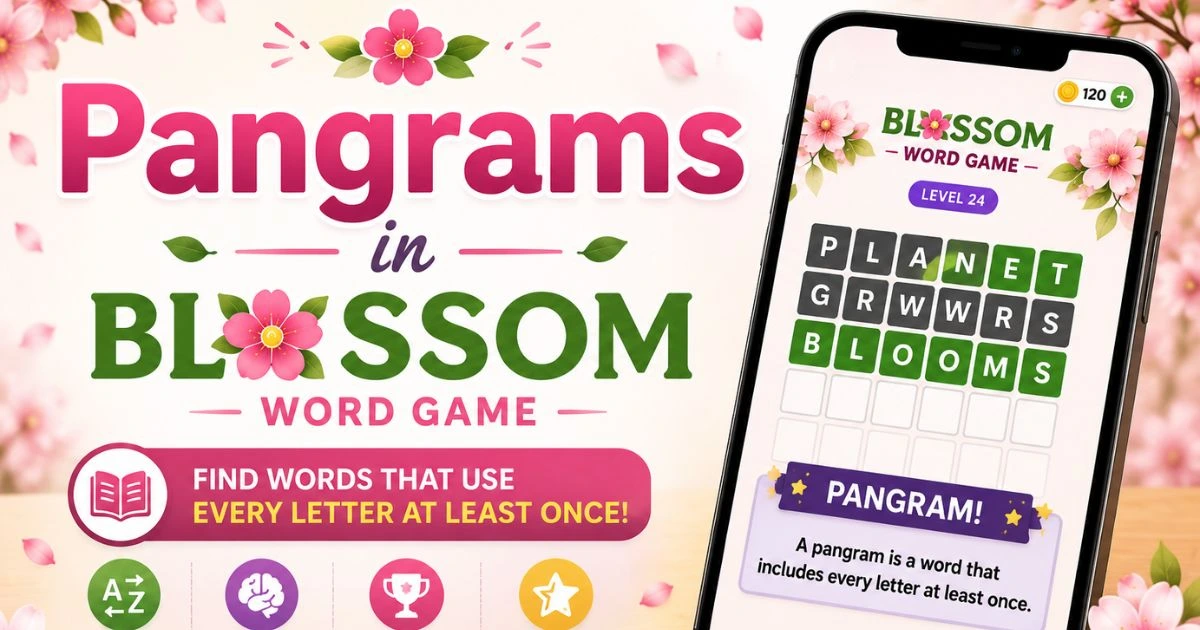
A pangram in Blossom is a single valid word that uses all seven letters shown in the flower puzzle — including the required center letter.
That’s it. Seven letters. One word. All of them were used at least once.
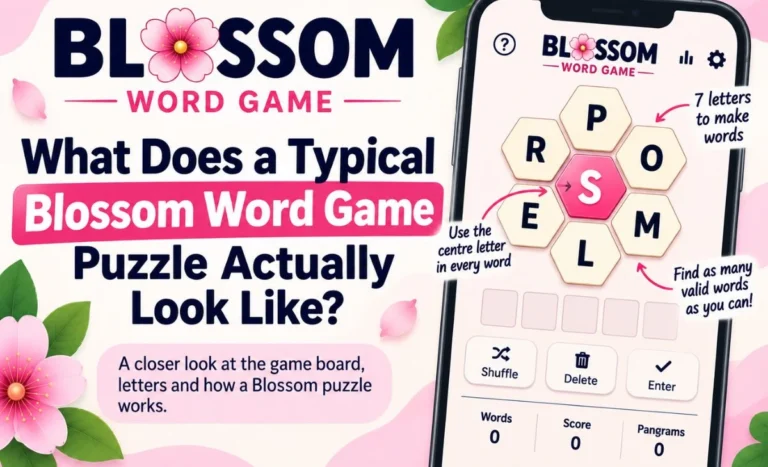
The puzzle gives you a flower shape: six outer letters arranged in a ring around one center letter. Every word you build must include that center letter. A pangram takes it a step further — it uses every letter in the flower, not just the center one.
Some puzzles have one pangram. Some have two. A small number have none at all, though that’s rare. When the puzzle is set each day, the design typically aims to include at least one.
Why Pangrams Matter: The Bonus Points Explained
Finding a pangram gives you a significant scoring advantage. Here’s why it matters more than just finding a long word.
When you find a pangram in Blossom Word Game, you earn bonus points on top of the regular word score. The bonus is substantial enough to push your total into a higher performance tier — moving you from “Good” to “Great” or even higher.
Here’s how the scoring stacks up in general terms:
- 3-letter words earn the fewest points
- Longer words earn progressively more
- Pangrams earn the full word score plus a bonus for using all seven letters
The exact bonus amount varies slightly depending on the puzzle, but consistently finding pangrams is one of the fastest ways to climb from an average score to a top-tier one. Players who miss pangrams regularly are leaving points behind every single day.
If you’re trying to understand exactly where pangrams fit into the full points system, the Blossom Word Game scoring guide breaks down every level in detail — including what separates a good score from a great one.
How to Find Pangrams in Blossom: 7 Practical Strategies
Finding pangrams is a skill. It gets easier the more you practice it. These seven methods give you the best shot at finding one before you move on.
1. Count the Unique Letters First
Before you type a single word, look at the seven letters in the puzzle. Count how many distinct letters you’re working with. If two letters repeat (for example, two vowels that look similar), you only need to use the unique ones. This helps you filter your search faster.
2. Start With the Vowels
Most 7-letter pangrams are built around the vowels in the puzzle. Identify every vowel in your flower. Then think of word structures that could hold all of them. Words with three or more vowels are often strong candidates.
3. Think in Suffixes and Prefixes
Common word endings are your best friends in a pangram hunt. Try attaching common suffixes to whatever letters you have:
-ing, -tion, -ness, -ment, -ful, -less, -ous, -ary, -ery, -ify
Work backwards. If you see Q, X, Z, or J in the puzzle, build outward from that hard letter first — it’s easier to build a word around a difficult letter than to bolt one on at the end.
4. Write the Letters Out Physically
This sounds basic. It works every time. Write all seven letters on paper or type them into a notepad. Rearrange them. Move the vowels together. Cluster the consonants. Your brain sees patterns differently when letters exist outside the digital flower shape.
5. Look for 7+ Letter Words in Your Head
If a word pops into your head that feels long — eight, nine, ten letters — check whether it uses all seven puzzle letters as a subset. Longer words are often pangrammatic naturally because they use so many different letters anyway.
6. Use the Center Letter as Your Anchor
The center letter is compulsory in every word. So the pangram must contain it. Use it as your starting point. Build words that feature that center letter prominently — not just tacked on at the end. Words where it sits in the middle of the word, or leads it, are often the pangrammatic ones.
7. Don’t Give Up at the Common Words
Most players find the obvious 3–5 letter words, feel satisfied, and move on. Pangrams almost always sit in the less obvious territory. Once you’ve listed every word you know easily, that’s when the real search begins. Stay with the puzzle for another two or three minutes beyond your comfort zone. Pangrams hide in that extra time.
What If There’s No Pangram Today?
Some puzzles genuinely don’t include a pangram — or at least none that are accessible to everyday players. If you’ve tried every method above and come up empty, there are two possibilities:
- The puzzle has one, but you haven’t found the word yet: This is the most common situation. The word exists in the puzzle’s dictionary, but it’s uncommon enough that most players miss it.
- The puzzle’s pangram is obscure: Occasionally the pangram is a technical, archaic, or highly specific word that fluent English speakers wouldn’t normally encounter. In these cases, missing it is completely understandable.
What you should never do is skip the rest of the puzzle looking for it. Pangrams matter, but so do your regular 4, 5, and 6-letter scores. Find as many words as you can first, then hunt the pangram on top.
If you want a daily head start before you play, the Blossom Word Game answers page is updated every day with solutions — including the pangram when there is one.
Pangrams and Score Tiers: Where Do You Land?
The Blossom scoring system ranks your performance across named tiers — from beginner-level all the way to the top. Finding a pangram pushes you up one or even two tiers compared to a game where you missed it.
Here’s the thing many players don’t realize: two players can find the same words and land in different tiers based purely on whether one of them found the pangram.
That gap compounds over time. A player who consistently finds pangrams will outrank most others not because they have a larger vocabulary — but because they’ve trained themselves to look for that one word every session.
This is why the pangram isn’t just a bonus feature. It’s the highest single-moment impact play available in each puzzle. One word. Maximum reward.
Common Pangram Mistakes and How to Avoid Them
Mistake 1: Assuming the Pangram Is Always Long
Pangrams in Blossom can be as short as seven letters — one use of each puzzle letter. They don’t need to be long. A 7-letter pangram scores the bonus just as much as a 10-letter one.
Mistake 2: Ignoring Less Common Letter Combinations
Players often dismiss letters like V, W, K, or X. But those are frequently the letters the pangram is built around. If those letters sit in your puzzle, spend more time on them, not less.
Mistake 3: Thinking Pangrams Are Only for Advanced Players
Pangrams feel like an expert feature. They’re not. The puzzle’s difficulty is set across a wide range by design. Some days the pangram is a familiar everyday word that many people know and simply didn’t think to try in this context. Beginners find pangrams all the time.
Mistake 4: Giving Up After the First 10 Minutes
The brain works differently under time pressure. Many people find their pangram in a relaxed second pass — after they’ve already written down everything obvious. Give it that second look before you close the tab.
Pangram Game vs. Other Daily Puzzles
Blossom isn’t the only pangram game around. NYT Spelling Bee works on a similar mechanic. But there are key differences.
In Spelling Bee, the word list is much larger. You can earn points all day. In Blossom Word Game, the puzzle resets daily and the word list is fixed. That means the pangram hunt has a hard deadline — and a clear end state.
That daily pressure is part of what makes finding a Blossom pangram feel rewarding. You either found it today or you didn’t. Tomorrow is a new puzzle and a fresh chance.
If you enjoy pangram games broadly and want to compare Blossom to similar options, there’s a full breakdown of comparable games at the other word games section on the site.
Quick Summary: Pangrams in Blossom at a Glance
- A pangram in Blossom = one word using all 7 puzzle letters including the center
- Finding it gives you a bonus on top of the regular word score
- Most puzzles have at least one pangram; some have two
- The best strategies: start with vowels, work from hard letters, use suffixes, look beyond the obvious
- Missing the pangram is the single biggest lost-points mistake in the game
- Daily answers are available if you want to check whether you found everything
Frequently Asked Questions
What is a pangram in Blossom Word Game?
A pangram in Blossom is a single word that uses all seven letters shown in the puzzle, including the mandatory center letter. It earns a bonus score on top of its normal word value.
How many pangrams does each Blossom puzzle have?
Most daily puzzles contain one pangram. Some have two. Occasionally a puzzle may have none, though this is uncommon. Each puzzle is typically designed to include at least one.
Does finding a pangram always help your score?
Yes. Every pangram you find adds bonus points to your total, regardless of how long the word is. It also contributes to pushing your score into a higher performance tier for that day.
Is the pangram always a common word?
Not always. Some days the pangram is a familiar word you’d use in conversation. Other days it’s technical, archaic, or unusual enough that most players miss it. Don’t assume it will be obvious.
What letters should I focus on when looking for a pangram?
Start with the vowels to understand the word structure available to you. Then focus on any uncommon consonants — V, W, K, X, J, Q — because words built around those letters are often the pangrams that players overlook.
Can I use the solver to find pangrams?
You can. A word solver will show you all valid words from the puzzle letters, and pangrams will typically appear clearly as 7+ letter words using the full set. Whether you use a solver is your choice — many players prefer the satisfaction of finding it themselves.
What happens if I can’t find the pangram?
Nothing happens in the game. You simply miss the bonus points for that day. The puzzle moves on when the day resets. It’s worth practicing the strategies above so each day’s hunt gets a little easier.
Conclusion
Pangrams are not just a bonus feature in Blossom Word Game — they are the fastest way to boost your score and move into higher performance tiers. Most players miss them simply because they don’t know what to look for. Once you understand the patterns, the search becomes much easier.
By focusing on letter combinations, using prefixes and suffixes, and giving yourself a second pass at the puzzle, you dramatically increase your chances of finding a pangram every day. It’s not about having a bigger vocabulary — it’s about using a smarter approach.
If you want to keep improving and learn more advanced strategies, explore more guides and tips on our blog.Keep practicing daily. Each puzzle is a new opportunity — and the more you train your brain, the easier those hidden pangrams become to spot.