Blossom Word Game Glossary — Every Term Explained
Confused by a term like “pangram” or “centre letter” while reading about Blossom Word Game? This glossary defines every term used across our guides — plain English, no jargon, alphabetically easy to scan.
Core Gameplay Terms
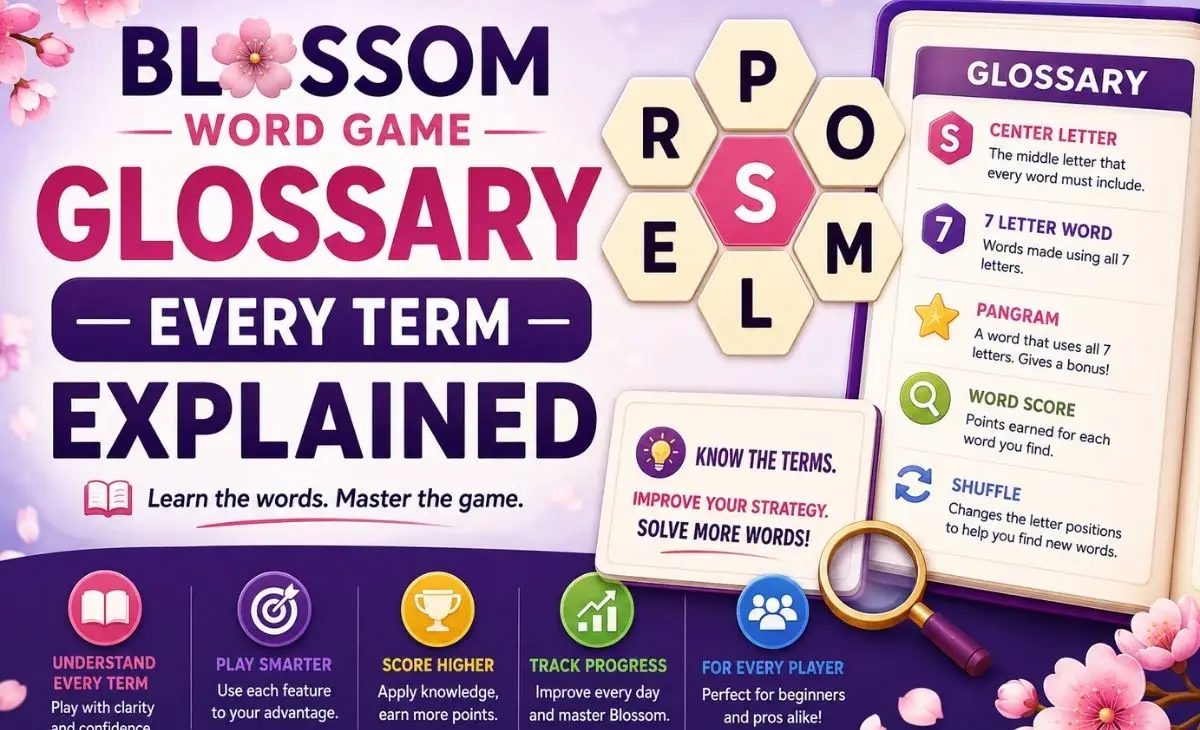
Centre letter
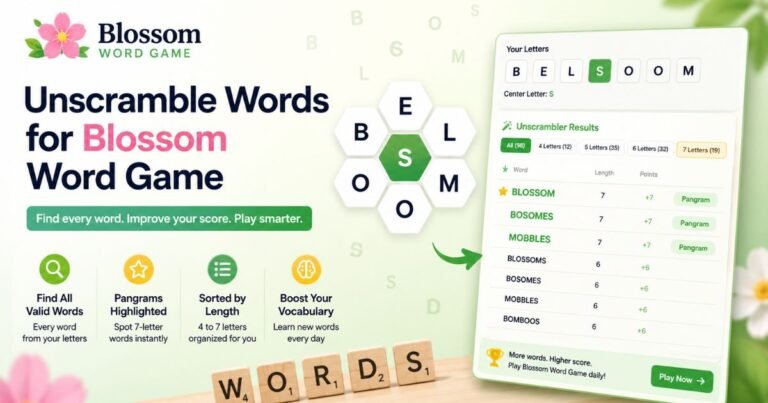
The single letter positioned in the middle of the flower shape. Every valid word submitted must include this letter at least once, regardless of where in the word it falls. The full rule set is covered in the rules and scoring guide.
Petal letters
The six letters arranged around the centre letter. Along with the centre letter, these make up the full set of seven letters available for that day’s puzzle.
Honeycomb layout
The general term for this style of puzzle, where letters are arranged in a hexagonal, flower-like grid rather than a straight line. It’s the same underlying structure used across several similar daily word games.
Pangram
A word that uses every one of the seven available letters at least once. Not every daily puzzle contains one, but when it does, finding it typically earns the largest single score boost available that day — the pangram guide covers how to spot one faster.
Letter repetition
The rule that allows a single letter shown on the flower to be used more than once within the same word, even though it only appears once visually. A word like LEVEL, for example, relies on this rule.
Scoring Terms
Base score
The points awarded purely for a word’s length, before any bonus is added. Longer words generally earn a higher base score than shorter ones.
Pangram bonus
The additional points awarded specifically for finding a pangram, on top of whatever base score the word’s length would normally earn.
Word count
The total number of valid words a given puzzle contains. This varies from one day to the next depending on the specific letters in play.
Rule-Related Terms
Rule rejection
When a submitted word fails a basic gameplay requirement — usually missing the centre letter or falling below the minimum length — before it’s even checked against the dictionary.
Dictionary rejection
When a word satisfies every gameplay rule but isn’t included in the accepted word list, even if it’s a genuinely common English word elsewhere.
Minimum word length
The shortest a word is allowed to be for submission. In this format, that threshold is four letters — anything shorter is rejected automatically.
Player Terms
Word extension
Taking a word you’ve already found and adding a common ending to create a new, separate valid word — for example, extending BAKE into BAKED or BAKER. This is one of the core habits covered in the strategy guide.
Session
A single sitting spent playing that day’s puzzle, from opening the letters to stopping for the day. There’s no time limit attached to a session.
Daily reset
The point at which the current puzzle is replaced with a fresh set of letters, typically at midnight. Once reset happens, the previous day’s letters and progress are gone.
Frequently Asked Questions
What’s the difference between the centre letter and petal letters?
The centre letter is the single letter every word must include. The petal letters are the remaining six letters surrounding it, which can be used freely but aren’t individually required.
Is a pangram the same as a long word?
Not necessarily. A word can be seven letters long without using all seven unique letters on the flower — that wouldn’t count as a pangram. A pangram specifically means every one of the seven distinct letters appears somewhere in the word.
Why do some words let you repeat a letter and others don’t seem to?
Repetition is always allowed by the rules — whether a specific word uses a repeated letter simply depends on how that word is spelled, not on any special permission needed.
Knowing these terms doesn’t change how the puzzle plays, but it does make guides, tips, and discussions about the game far easier to follow — particularly the difference between a rule rejection and a dictionary rejection, which explains most of the confusion new players run into early on.