Why Was My Word Rejected in Blossom Word Game?
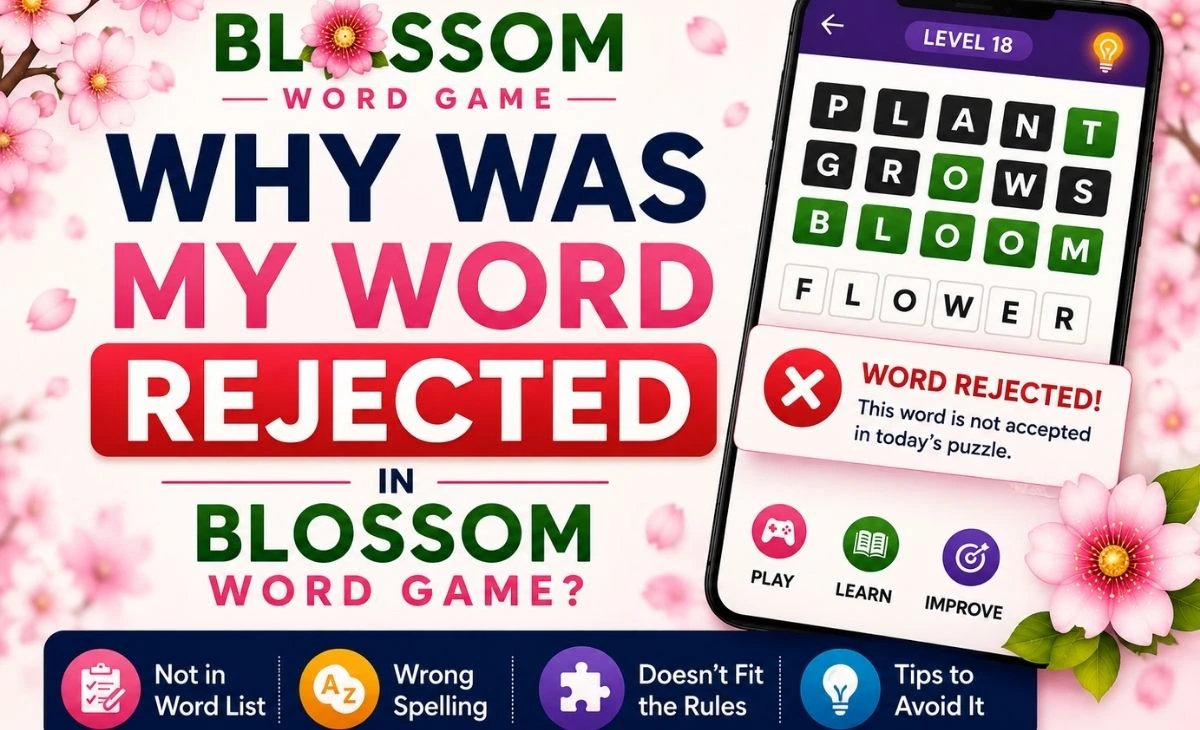
You’ve built a word you’re certain is real, hit submit, and it bounces straight back. It’s one of the most common frustrations in Blossom Word Game, and nearly every rejection falls into one of a small number of predictable causes.
Two Different Kinds of Rejection
Players tend to lump every rejection into the same category, but there are actually two separate things happening, and mixing them up is where most of the confusion comes from.
The first is a rule failure. The word never even reaches the dictionary check — it’s rejected because it breaks a basic requirement of the game itself, covered in full in the complete rules guide.
The second is a dictionary miss. The word satisfies every rule but simply isn’t included in the puzzle’s accepted word list, even though it might be perfectly normal English.
Rule Failures — Easy to Spot Once You Know Them
These have nothing to do with vocabulary. They’re mechanical, and they’re the quickest to fix.
No centre letter: This is the single most common mistake. A player builds a genuinely strong word, submits it, and only afterwards notices the centre letter wasn’t included anywhere in it. Checking for this before pressing enter, rather than after a rejection, saves a surprising amount of frustration.
Under four letters: Anything shorter than four letters is turned away automatically. This applies regardless of how common the word is — three-letter words simply don’t count in this format.
A letter that isn’t on the flower: Every letter used has to come from the seven shown. Reusing a letter that’s already there is fine; using one that isn’t present at all isn’t.
Dictionary Misses — Where Real Words Still Fail
This is the category that causes genuine confusion, because the word can be completely legitimate English and still not count here.
Names and brands: LONDON, TESCO, EDINBURGH — proper nouns aren’t accepted, no matter how correctly spelled.
Hyphenated or two-word entries: Words like WELL-KNOWN or SELF-AWARE exist as hyphenated dictionary entries, but the hyphen alone disqualifies them here. If a word only exists in that joined-with-a-hyphen form, it won’t work.
Abbreviations: Shortened or informal forms generally aren’t part of the accepted list.
Words sitting right on the edge of common usage: Occasionally a word is technically valid but obscure enough that it falls outside what the puzzle’s dictionary treats as standard. A word solver can help confirm whether a tricky word is genuinely in the list before you waste time retrying it.
If You’re Sure the Word Is Real, Try the Family
Before writing a word off entirely, test its close relatives. If the base form fails, try the plural. If the plural fails, try the past tense or the -ing form. It’s common for one member of a word family to be accepted while another isn’t — there’s rarely a way to predict which in advance, so it’s worth a quick try.
A Checklist Before You Submit
- Does the word contain the centre letter?
- Is it at least four letters long?
- Are every one of its letters actually on the flower?
- Is it a genuine common word, not a name, abbreviation, or hyphenated term?
If a word clears all four points and still gets rejected, it’s most likely a narrow dictionary gap rather than anything you’re doing wrong. At that point, the more productive move is to try a related form or simply carry on with the puzzle.
Frequently Asked Questions
Why does Blossom sometimes reject a word that’s obviously real?
Usually because it isn’t included in the specific word list the puzzle checks against, or because it’s a proper noun, abbreviation, or hyphenated compound — categories that don’t count regardless of how common the word is elsewhere.
Does a rejected word cost me anything?
No. There’s no penalty. It simply doesn’t register, and you can try again straight away.
One form of a word worked but another didn’t — why?
Word lists don’t always cover every grammatical form of a word equally. If the root is accepted but an extended form isn’t, that’s a gap in the list rather than a rule you’ve broken — worth testing the rest of the family before assuming the whole word is invalid.
Is there any way to predict rejections before submitting?
Not with total certainty, but running through the checklist above filters out the vast majority of rejections in advance.
Most rejected words fall into a handful of predictable patterns once you know what to look for. The rule-based ones fix themselves quickly with a habit of checking before you submit; the dictionary edge cases are worth a brief second attempt and then simply letting go — or a glance at today’s hints if you’d rather have a nudge than keep guessing.