Blossom Word Game Review: Is It Actually Worth Your Morning?
I’ve spent the past few weeks playing Blossom Word Game daily to work out whether it’s actually worth adding to your morning routine — not just describing the rules, but weighing what it does well and where it genuinely falls short. Short verdict first: it’s one of the cleanest word games online right now, with one honest downside — almost no extras beyond the puzzle itself.
How the Puzzle Actually Works
Here’s where a lot of write-ups get sloppy, so let’s be precise.
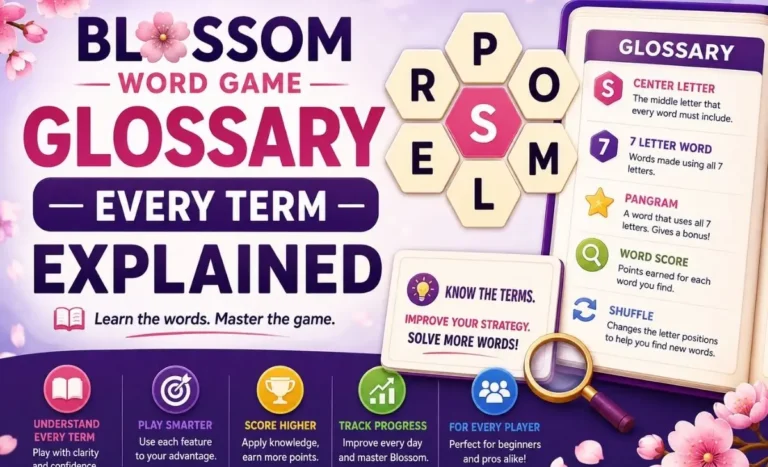
Each day you get seven letters set out like a flower. One sits in the centre. The other six form the petals. Every word you submit must:
- Be at least four letters long
- Include the centre letter
- Be a real word — no proper nouns, no hyphenated words, no slang
You can reuse a letter more than once in the same word. That’s an easy detail to miss, and it changes your strategy once you know it.
The part almost nobody mentions clearly: the puzzle is solved once you find 12 words. This isn’t an endless word-hunt like some clones suggest — it’s a fixed target. Longer words score more points than short ones, and at least one of the twelve words each day is a pangram — a word that uses all seven letters. Find it, and you get a solid bonus on top of your score.
There’s no timer. You can sit with the puzzle for two minutes or twenty.
What Blossom Gets Right
The word list doesn’t argue with you: A standard English dictionary sits behind every accepted word. If the game rejects something, it’s not a bug or a bad word list — it just isn’t in the dictionary. That’s rarer than it sounds. A lot of word games online use crowd-sourced lists that accept oddities or reject perfectly good words.
Nothing gets in your way: No sign-up screen. No email capture. No “watch an ad to continue.” You load the page and you’re playing within seconds.
It rewards actual improvement: Because the word list is fixed and fair, players who’ve been solving for months genuinely score higher than beginners — not because the game got easier, but because their own vocabulary grew. That’s a rare thing for a browser puzzle to pull off honestly.
The twelve-word structure keeps it tight: Games without a clear stopping point can turn into a grind. Knowing there are exactly twelve words to find gives the puzzle a real finish line, and that finish line is part of why it’s satisfying.
Where It Falls Short
No way to share your score: Wordle exploded partly because of that little coloured grid people posted everywhere. Blossom has nothing like it. If you finish a great puzzle, there’s no built-in way to show anyone.
Yesterday’s puzzle is gone: There’s no archive. Miss a day, and that puzzle simply doesn’t exist for you any more. Players who want to practise on old puzzles are out of luck.
You’re flying blind mid-puzzle: The game won’t tell you how many of the twelve words you still need, or hint that a pangram is sitting there unfound. Some players like that purity. Others find it frustrating.
It’s a browser game, not an app: It works fine on a phone screen, but it wasn’t built specifically for mobile the way a dedicated app would be. Nothing broken — just not as polished as it could be.
A Quick Word on Trust
If you’ve searched around for Blossom Word Game reviews, you may have run into pages describing it as a mobile app with “120 levels,” a “weight-gain game,” or something involving connecting letters in a garden with a soundtrack. None of that describes the honeycomb-style Blossom puzzle covered on this site. Those pages appear to be confusing it with a different, unrelated app that happens to share the name, or are simply generated without anyone checking the facts. The version covered here is a single daily puzzle with no levels, no in-game purchases, and no soundtrack. Worth knowing before you go looking for it in an app store.
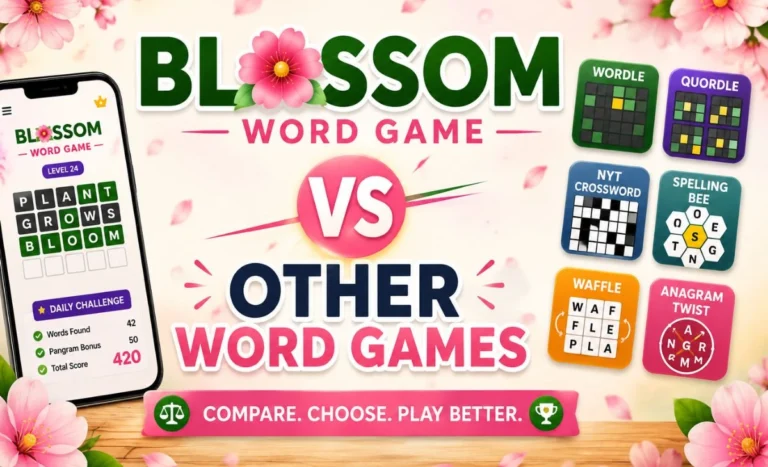
Blossom vs. NYT Spelling Bee vs. Wordle
Blossom vs. Spelling Bee: Same honeycomb shape, same centre-letter rule. The real difference is the business model. Spelling Bee comes from the New York Times and locks most of its features behind a subscription, along with a ranking system from Beginner to Genius. Blossom skips all of that and stays fully free, which makes it the more practical pick if you just want the format without paying.
Blossom vs. Wordle: These barely resemble each other despite both being daily puzzles. Wordle asks you to deduce one specific word from colour-coded feedback. Blossom asks you to generate as many valid words as you can from a fixed letter set. One is a logic puzzle, the other is a vocabulary puzzle. Plenty of players do both every morning because they exercise different parts of the brain.
Mistakes New Players Make
A few things trip people up early on:
- Forgetting the centre letter is mandatory: Every single word needs it. A great five-letter word that skips the centre letter won’t count.
- Not trying letter repeats: Since letters can repeat, words with doubled-letter patterns are fair game if the letters allow it — a lot of new players assume each letter can only be used once.
- Chasing short words only: Four-letter words are the easiest to find, but they cap your score fast. Slowing down to look for six- and seven-letter combinations pays off.
- Giving up before checking for the pangram: It’s always there. It’s usually the hardest word to spot, and it’s worth actively hunting for rather than stumbling on by accident.
Who Should Play This
Blossom fits you well if you already play Wordle and want a second puzzle with more depth. It also suits anyone who wants real vocabulary growth rather than a quick guessing game, and anyone who’s tired of daily puzzles asking for an account before they’ll let you play.
It’s a weaker fit if you want social features, a competitive leaderboard, or the option to replay puzzles from last week. For that, Spelling Bee’s subscription tier or a different game entirely will serve you better.
FAQ
Is Blossom Word Game really free?
Yes. No account, no subscription, no in-game purchases. The full daily puzzle costs nothing.
How many words do I need to find?
Twelve. That’s the fixed target for every daily puzzle.
Can I reuse a letter in one word?
Yes. Letters can repeat within the same word — this trips up a lot of new players.
Is Blossom the same game as NYT Spelling Bee?
They share the same honeycomb format and centre-letter rule, but they’re published separately with different word lists. Blossom is free throughout; Spelling Bee gates most features behind a subscription.
Can I play on my phone?
Yes, through any mobile browser. There’s no dedicated app.
Is there an archive of past puzzles?
No. Each day’s puzzle is replaced by the next one, with no official way to revisit older puzzles.
Final Take
My verdict after weeks of playing: Blossom doesn’t try to hook you with streaks, notifications, or a shop full of power-ups. It gives you seven letters, a clear goal of twelve words, and gets out of the way. The missing archive and social features are real gaps, but they don’t touch what actually matters in a word game — a fair word list and a puzzle worth solving.