Blossom Word Game Scoring Explained – Points, Levels & High Score Tips
You finish the puzzle, look at your final score, and wonder if it’s any good? The scoring in Blossom Word Game isn’t random, but it’s not entirely transparent either. There’s no official breakdown of exactly how each word translates into points. What players know comes from thousands of sessions and careful observation.
How Blossom Word Game Scoring Works
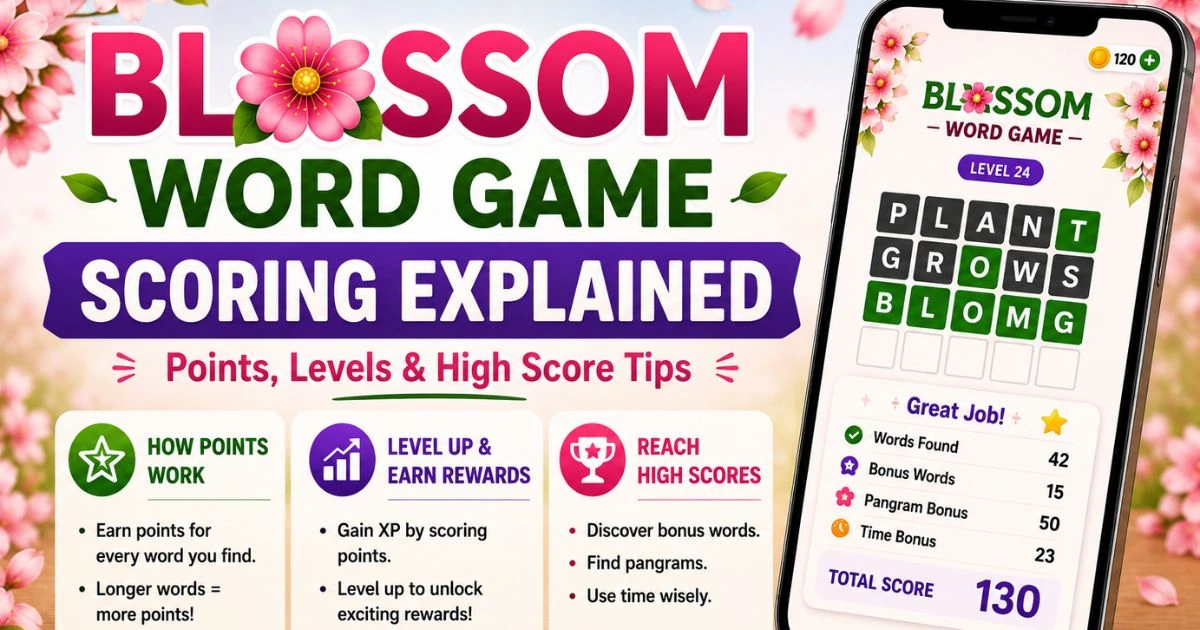
The Blossom Word Game awards points based on word length. Short words earn fewer points. Longer words earn more. The relationship between length and points is not linear — each additional letter adds proportionally more value than the last.
The core logic works like this:
- A four-letter word earns a base amount — typically one point
- Each letter beyond four adds a point per letter
- A pangram — a word that uses all seven puzzle letters — earns its length-based points plus a bonus that can substantially lift your total
This means a single seven-letter pangram can be worth more to your score than five or six short words. Players who focus entirely on finding four-letter words often plateau because they are playing efficiently but not scoring efficiently.
Points Per Word Length
| Word Length | Approximate Points |
| 4 letters | 1 point |
| 5 letters | 5 points |
| 6 letters | 6 points |
| 7 letters | 7 points |
| 7-letter pangram | 7 points + pangram bonus |
Note: Exact point values can vary slightly between puzzles. These figures reflect the most consistent patterns observed across daily sessions.
What Is a Good Score in Blossom Word Game?
A good score depends on how long you have been playing, how much time you spend on each puzzle, and how wide your vocabulary runs. There is no single target that applies to every player.
The table below gives practical benchmarks for different experience levels. These figures are based on typical performance patterns among UK players.
| Player Level | Typical Score Range | What It Reflects |
| Beginner (first 2 weeks) | 0 – 40 points | Learning the rules and the center-letter requirement |
| Casual (plays most days) | 41 – 80 points | Finds common words, misses less obvious ones |
| Regular (plays daily) | 81 – 140 points | Consistent word-finding with occasional longer words |
| Experienced | 141 – 220 points | Actively hunts longer words and pangrams |
| Expert | 221 – 300+ points | Finds most of the word list, rarely misses pangrams |
The average score among regular UK players sits somewhere between 70 and 90 points. If you are consistently hitting 100 or above, you are performing above the general average. Scores past 200 put you in a small group of highly experienced players.
What Score Levels Mean in Practice
Score milestones appear as you play. These milestones serve as markers of progress within a session, not a ranking against other players. Understanding what the thresholds mean helps you set realistic targets.
0–20 points — You are warming up. Most players in this range have found a handful of four-letter words and are building from there.
21–60 points — Solid early progress. You have likely found all or most of the obvious short words and are beginning to push toward five-letter answers.
61–100 points — This is where most regular players sit by the end of a session. You have found a solid range of words including some longer ones.
101–150 points — You are playing above average. This range usually involves finding several five and six-letter words and possibly one longer word or pangram.
151–200 points — Strong performance. Players here have found a significant portion of the available word list, including words that require a broader vocabulary.
200+ points — Expert territory. Reaching this range consistently requires finding most of the word list and the pangram on days when one is available.
Why Your Score Varies Day to Day
Your score will not be the same every day even if your skill level stays constant. The puzzle’s letters change daily, and some combinations produce more valid words than others. A puzzle built around common vowels and frequent consonants generates a longer word list. A puzzle with unusual letter combinations offers fewer options even for experienced players.
This means a score of 80 on one day and 60 on another does not necessarily reflect a drop in performance. The puzzle difficulty varies. Comparing your score to your own trend over time is more useful than comparing individual sessions.
How to Improve Your Blossom Word Game Score
These habits consistently move scores upward for players at every level.
Find All Four-Letter Words First
It is tempting to aim for long words immediately, but clearing the four-letter words first gives you a stable base score and often reveals letter patterns that point toward longer answers. Missing several four-letter words to chase a pangram that does not appear is a common mistake among intermediate players.
Target Five and Six-Letter Words Actively
Most score improvement for players in the 60–100 point range comes from finding more five and six-letter words, not from finding the pangram. Five-letter words alone score five times more than a four-letter word. Building the habit of stretching every short word into a longer form — trying BAKE, BAKER, BAKERS, BAKED in sequence — adds consistent points.
Hunt the Pangram at the End
Spend the first part of your session finding words naturally. In the last few minutes, shift deliberately to pangram-hunting. Try common seven-letter word structures using your letters. Many players who never find pangrams simply do not spend focused time looking for them.
Use Prefixes and Suffixes Systematically
After finding a root word, extend it in every direction. A word like FOLD gives you FOLDS, FOLDED, FOLDER, FOLDERS if the letters are there. Systematically testing every root word for valid extensions is one of the highest-yield habits a Blossom player can build.
Review What You Missed
After each session, check the Blossom Word Game answers page to see the full word list. Pay attention to words you did not find. If they are words you know, note which patterns you missed. If they are words you do not know, look them up. This review habit does more for long-term score improvement than any other single practice.
Blossom Score FAQ
Does Blossom Word Game show your score to other players?
No. The Blossom Word Game does not have a public leaderboard or social sharing built in. Your score is private unless you choose to share it yourself.
Is there a maximum possible score?
Yes, in theory. Each puzzle has a fixed word list and a maximum total if every valid word is found. In practice, no player finds every word in every puzzle. The theoretical maximum varies by puzzle depending on how many valid words the letter combination generates.
Does the order I enter words affect my score?
No. Points are awarded per word regardless of the order you submit them. There is no bonus or penalty for the sequence in which words are entered.
What counts as a word in Blossom Word Game?
Only words found in a standard English dictionary. Proper nouns, abbreviations, and slang do not count.
Can I get bonus points for anything other than pangrams?
The primary bonus mechanic in the Blossom Word Game is the pangram bonus. Score milestones within a session may display recognition messages, but these do not change the underlying point total.
Final Thoughts
Your score is a number, but what it actually measures is pattern recognition built over time. A beginner scoring 40 points and an expert scoring 250 points are playing the same puzzle with the same letters. The difference is not intelligence — it is accumulated habit.
The scoring system rewards exactly the right things. Short words give you a foundation. Longer words give you momentum. The pangram gives you a peak to aim for. Each session has a natural arc, and understanding that arc is what separates players who plateau from players who keep improving.
If your score has felt stuck, come back to the benchmarks in this guide. Find which level you are in, identify the single habit that moves players out of that level, and build it into your next ten sessions. The improvement will follow.