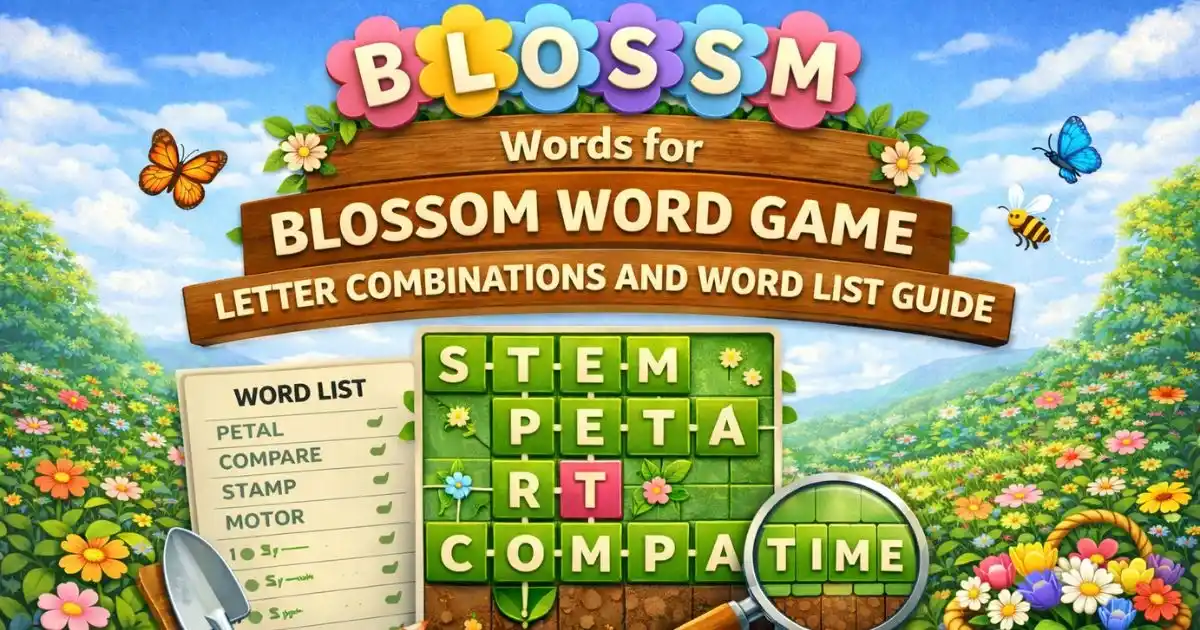
Words for Blossom Word Game – Letter Combinations and Word List Guide
The Blossom Word Game rewards players who know a wide range of words across different lengths and letter patterns. The daily puzzle gives you seven letters and asks you to find every valid combination. The difference between a player who scores 60 and one who scores 150 is rarely vocabulary — it is the ability to see the words that are hidden inside a set of letters.
This guide covers the letter patterns that appear most often in Blossom puzzles, the word structures that produce the most valid entries, and the specific vocabulary habits that help you find more words every day.
How Letter Combinations Affect Your Word Count
Not all Blossom puzzles are equal. A day with common vowels and frequent consonants generates a long available word list. A day with unusual or restrictive letters generates fewer valid words. Understanding this helps you set realistic expectations rather than assuming a low score means poor play.
Vowel Patterns
The vowels in your puzzle determine which word shapes are available. The most productive vowel combinations in English — letters that appear in many valid words — are A, E, and R together. These three letters appear in thousands of valid words across multiple lengths.
Less productive vowel sets tend to involve Q, X, Z, or J. These letters appear in far fewer common words. A Blossom puzzle with Z as the center letter has a shorter valid word list by nature.
| Vowel/Letter Type | Examples | Word Availability |
| A, E, R together | Many combinations | Very high |
| I, N, G together | Many combinations | High |
| O, L, E together | Many combinations | High |
| Q, X, Z, J anywhere | Rare combinations | Low |
Common Word Patterns in Blossom Puzzles
Certain word structures appear frequently in valid Merriam-Webster word lists and therefore appear often in Blossom puzzles. Knowing these patterns does not tell you what today’s words are, but it primes your brain to look for familiar shapes.
Four-Letter Word Families
Four-letter words are the backbone of every Blossom session. They earn one point each but they also reveal patterns that point to longer words. The most common four-letter patterns in English involve:
CVCC patterns (consonant-vowel-consonant-consonant): BAND, BOLD, COLD, FOLD, HOLD, MELT, FELT
CCVC patterns (consonant-consonant-vowel-consonant): BRIM, DRIP, GRIN, SLIM, TRIP
CVCV patterns (consonant-vowel-consonant-vowel): ABLE, BALE, BORE, CAME, DARE, FAME, LANE
In Blossom, you are looking for four-letter combinations that include the center letter and only use letters from your grid. Knowing the most common shapes speeds up your recognition.
Five-Letter Word Families
Five-letter words earn five points each — a significant jump from the one point awarded for four-letter words. The most productive five-letter patterns involve common suffixes:
Words ending in -TION: Rare at five letters but worth knowing
Words ending in -NESS: DARKNESS, ILLNESS — usually longer but -NESS is worth testing
Words ending in -MENT: CEMENT is five letters — worth testing when C, E, M, N, T are available Words ending in -LING: OGLING, COILING — productive when L, I, N, G are present
Words ending in -ABLE: CABLE, TABLE, FABLE — when A, B, L, E appear
For five-letter words, the most consistent strategy is to take every four-letter word you found and test every standard extension. BLEND → BLENDS, BLOKE → BLOKES, BLOOM → BLOOMS. If the letter is in your grid, the extended form usually qualifies.
Six-Letter Word Families
Six-letter words earn six points — roughly equal to six four-letter words. Finding one or two genuine six-letter words per session separates regular players from average ones.
Common six-letter patterns in Merriam-Webster’s word list:
-ER + S extensions: Any five-letter word ending in -ER can often be extended to the plural -ERS. FOLDER → FOLDERS, FARMER → FARMERS, BONDER → BONDERS.
-ING extensions of five-letter roots: BLEND → BLENDING (seven letters — useful for pangrams), BLOOM → BLOOMING
Compound-style six-letter words: Words built from two three-letter components often qualify. BEDROOM, OUTLOOK — though these depend entirely on available letters.
Seven-Letter Words and Pangrams
Seven-letter words, and especially pangrams (words using all seven puzzle letters), earn the highest points. They are also the hardest to find. The most productive approach is to look for:
-TION words: MENTION, ORATION, CAUTION — all seven letters, contain common letters -MENT words: LEMENT — rare, but -MENT endings at seven letters do appear
-ING words: BLOOMING, FARMING, HOLDING — the -ING suffix used on five-letter roots often produces valid seven-letter words
-NESS words: BOLDNESS, FONDNESS, GOODNESS — seven letters, appear when the right consonant clusters are present
The Most Useful Words to Know by Letter
These words appear often in Blossom puzzles because they use high-frequency letters. Knowing them by heart means you find them quickly without deliberate searching.
Words Using Common Letters (A, E, R, S, T, N, L)
When your puzzle contains a high proportion of these letters, these patterns are worth checking first:
Four-letter: REAL, RENT, LENT, LEAN, LANE, SALE, TALE, RATE, LATE, SEAL, TEAL, EARN, NEAR, RANT, RANT, SENT, TENS
Five-letter: LATER, RENTS, LANES, TALES, RATES, LEANS, EARNS, RENAL, ALERT, ALTER, SNARE, STARE
Six-letter: RENTAL, LATERS, ALTERS, ALERTS, ANTLER, LEARNT, LEARNS
Words Using B, L, O, M, E
When B, L, O, M, or E appear in your puzzle (especially together), these are worth checking:
Four-letter: BLOB, LOBE, BOLE, MOLE, ELEM, MEOW, BLOOM
Five-letter: BLOKE, BELOW, BESOM, BLOOM, LEMON, MODEL, MOBLE
Six-letter: BLOOMS, BLOKES, LEMONS, EMBLEM
How to Build a Better Word Bank for Blossom
Playing the game improves your score over time, but deliberate vocabulary building improves it faster.
Review Every Missed Word
After each session, check the Blossom Word Game answers and identify words you did not find. For each one:
- If it is a word you know, note the pattern you missed and make a mental note to test that pattern in future sessions
- If it is a word you do not know, look it up in a dictionary, read the definition, and note when it would naturally be used
This review habit adds more to your available word bank than any amount of extra playing.
Learn the Merriam-Webster Word of the Day
Merriam-Webster publishes a word of the day. Many of these words are exactly the type that appears in Blossom puzzles — valid, formal, not necessarily in everyday speech. Following the word of the day for three months adds around ninety words to your active vocabulary, many of which eventually show up in puzzles.
Test All Extensions Every Session
The fastest way to find more words without learning new vocabulary is to systematically extend every word you find. For every valid word you enter, immediately try:
- Adding -S
- Adding -ED
- Adding -ER
- Adding -ERS
- Adding -ING
- Adding -LY (for adjectives)
- Adding -NESS (for adjectives)
- Adding RE- to the front
- Adding UN- to the front
This checklist takes ten seconds per word and typically surfaces two to four additional valid entries per session.
Letter Reference: What to Expect by Center Letter
The center letter determines the floor of your word list. Some center letters are more productive than others.
| Center Letter | Word Availability | Notes |
| E | Very high | Appears in more English words than any other letter |
| A | Very high | Second only to E in frequency |
| R | High | Appears in a very high proportion of English words |
| S | High | Many words end in S; useful as a center letter |
| T | Moderate-high | Common but more constrained as a center |
| N | Moderate | Useful in many suffixes but fewer roots |
| B, F, G, H | Moderate | Good in roots, fewer suffix connections |
| X, Z, J, Q | Low | Valid words exist but the list is shorter |
If your center letter is E, A, or R, expect a long word list and aim for a higher score. If it is X, Z, or J, a shorter list is normal and finding all available words still represents a strong performance.
Frequently Asked Questions
What is the minimum word length in Blossom Word Game?
Four letters. Words of three letters or fewer are not accepted regardless of how common they are.
Can I use the same letter twice in one word?
Yes. Each letter in the grid can be used multiple times in a single word, even though it only appears once in the honeycomb. If your center letter is E, a word like SLEEVE (which uses E twice) is valid as long as all letters come from your grid.
Does capitalisation matter?
No. All valid words are treated as lowercase regardless of how you type them. Proper nouns are not accepted — the game only accepts common dictionary words.
Are all forms of a word accepted?
Most standard forms are accepted — plurals, past tenses, gerunds, and comparative forms. Some very unusual verb forms or archaic conjugations may not be in Merriam-Webster’s active word list. When in doubt, submit and see.
How many words does a typical Blossom puzzle have?
This varies by the letter combination, but most daily puzzles contain between fifteen and forty valid words. Puzzles with common letters and productive combinations tend toward the higher end. Puzzles with unusual letters tend toward the lower end.
Final Thoughts
Finding more words in the Blossom Word Game is less about luck and more about habit. The letter patterns covered in this guide — four-letter word families, suffix and prefix extensions, vowel combinations — do not change from day to day. Once they are part of how you read the grid, they work on every puzzle automatically.
The single habit that moves scores the fastest is the simplest: extend every word you find before moving on. Test -S, -ED, -ER, -ING on every entry. That one habit alone is worth ten to fifteen extra points per session for most players.
Beyond that, the vocabulary you bring to the game matters more than any in-game technique. Read widely, review your missed words after every session, and the improvements will compound naturally over time.