Blossom Word Game Solver – How to Use One (And Should You?)
You have stared at the seven letters long enough. The center letter is clear, a few words have clicked, but the big score still feels out of reach. At some point, every Blossom Word Game player thinks about using a solver. This guide explains exactly what a Blossom Word Game solver does, how to use one properly, and whether it is actually worth it for your long-term game.
What Is a Blossom Word Game Solver?
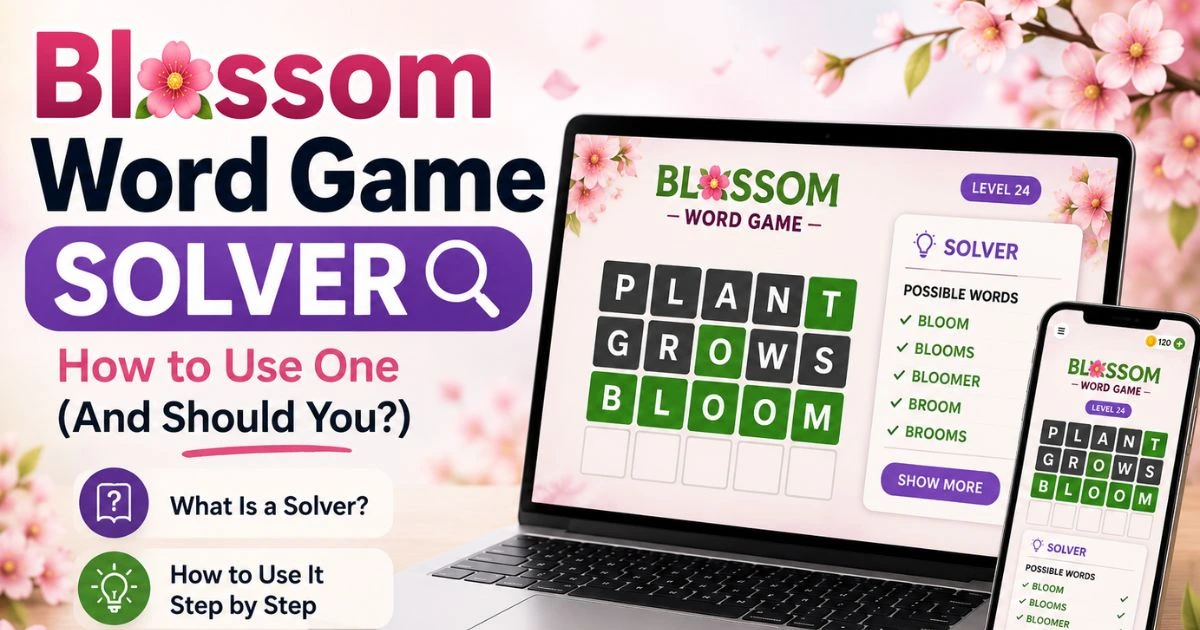
A Blossom Word Game solver is an online tool that takes your seven puzzle letters as input and returns every valid word you can make from them. You give it the center letter and the six outer letters. It gives you the complete word list, usually sorted by length or point value.
Some solvers also flag the pangram — the word that uses all seven letters — which is often the highest-value find in any given puzzle.
The Blossom Word Game itself does not include a built-in hint system.There is no official built-in solver. Every solver you find online is a third-party tool built by players or developers who reverse-engineered the puzzle format and word list.
How Does a Blossom Word Game Solver Work?
The mechanics behind a good solver are straightforward. Understanding them helps you judge whether a tool is reliable.
Step 1 – Input Your Letters
You enter the seven letters from your current puzzle. Most solvers ask you to specify which letter is the center. Some have you type all seven and select the center from a list. A small number of tools generate inputs from a screenshot — though these are rarer and less accurate.
Step 2 – The Tool Filters the Word List
The solver checks its internal dictionary against your letter set. For each word in its database, it asks two questions:
- Does this word use only letters from the given seven?
- Does this word include the center letter at least once?
If both answers are yes and the word is four or more letters long, it qualifies. Everything else is filtered out.
Step 3 – Results Are Returned
The output is a list of qualifying words. Better solvers sort these by length, by point value, or let you filter by starting letter. The best tools highlight pangrams separately so you do not miss them in a long list.
| What Solvers Show | What They Cannot Do |
| All valid words from your letters | Tell you which words the official game will accept |
| Pangram if one exists | Guarantee 100% alignment with the game’s live word list |
| Words sorted by length or points | Predict tomorrow’s puzzle |
| Estimated score range | Replace the understanding of why words work |
Should You Use a Blossom Word Game Solver?
This is the more important question. Using a solver is not cheating in any formal sense — there are no leaderboards, no prizes, and no rules against it. But it does change what you get from the game. Whether that change is positive depends entirely on how you use it.
If You Use It to Learn
Using a solver at the end of a session — after you have played properly and submitted your genuine score — is probably the most valuable way to use one. You check which words you missed, look up the ones you do not recognise, and add them to your mental vocabulary. Over time, this builds your word bank and genuinely improves your scores.
This is the approach competitive Blossom players recommend. Play first. Solve second. Study the gap.
If You Use It During Play
Running the solver while you are still playing replaces the puzzle with a copying exercise. Your score improves immediately. Your skill does not. If your goal is genuinely to challenge yourself, this approach undermines the whole experience.
That said, there are legitimate reasons to use a solver mid-game. If you are playing with a friend who is considerably more experienced and you want to stay competitive, a solver levels the field. If you are completely stuck and want to learn what the correct approach looks like before giving up, a solver teaches you something.
If You Use It Every Day
Daily solver use creates dependency. Players who always use a solver report that they cannot improve their unaided score over time because they never develop the skill independently. The vocabulary does not grow. The pattern recognition never sharpens. After six months of solver-assisted play, returning to unassisted solving can feel harder than it did at the start.
Word Finder vs Solver — Is There a Real Difference?
People search for “blossom word finder” and “blossom word game solver” almost interchangeably, and for most practical purposes they mean the same thing — both take your seven letters and return valid words. The small difference: a solver typically hands you the full list at once, while a word finder often lets you filter by length or starting letter, so you can search for exactly what you need instead of scrolling through everything.
If you specifically want to check whether a pangram exists today without seeing every shorter word, a filtered seven-letter search answers that one question in seconds — that’s the one genuinely useful reason to reach for filters instead of the full output.
How to Use a Blossom Word Game Solver Effectively
If you have decided to use one, these habits make the experience more useful.
Play the puzzle unaided first: Give yourself a full session — at least fifteen minutes — without any external help. Record your score. Then open the solver and check everything you missed.
Study the words you did not find: Do not just note the score gap. Look at each word the solver found that you missed. If you do not know the word, look it up. Read the definition. Use it in a sentence. That thirty seconds of effort is what turns solver use into genuine learning.
Focus on pangrams: If the solver reveals a pangram you missed entirely, that is a priority learning target. Pangrams often follow patterns. Understanding the logic behind common pangrams in the Blossom format helps you spot future ones without assistance.
Do not copy the word list line by line: If you are entering the solver’s answers one by one during active play, you are not playing the game. You are using the game’s interface to submit someone else’s answers. The difference between that and actually playing is obvious to anyone watching.
Solver Accuracy – What to Watch Out For
Not all Blossom Word Game solvers are equally reliable. The official game uses a carefully maintained word list. Third-party solvers use their own dictionaries, which may differ in meaningful ways.
You will sometimes encounter words that a solver suggests but the game rejects. This usually means the solver uses a broader or different dictionary. Common examples include archaic words, proper nouns that have entered general usage, and some American English spellings that differ from the game’s preferred forms.
The reverse also happens. Some solvers miss words that the official game accepts because their dictionary is more conservative or out of date.
The safest way to use a solver is to treat its output as a strong suggestion rather than a definitive answer. If a word it suggests gets rejected by the game, do not waste time entering variations. Move on.
What to Do Instead of a Solver
If you want to improve your Blossom score without relying on external tools, the most effective methods are also the simplest.
Build vocabulary deliberately: Read more. When you encounter an unfamiliar word, write it down and look it up. Players with wide reading habits consistently outperform those who only play word games to improve at word games.
Review your own missed words: After each session, try to recall which common words you overlooked. Ask yourself whether the letters were there and you simply did not see them. Most experienced players have blind spots — letter combinations they consistently miss. Identifying yours is more useful than any solver.
Use the Blossom Word Game daily answers page: Rather than running a solver mid-game, bookmark the answers page and check it after you finish. It shows you the full word list for the day in a clean format, which is easier to study than most solver outputs.
Focus on four and five-letter words: New players often skip short words in pursuit of longer ones. In reality, consistently finding every four and five-letter word in a puzzle often contributes more to your final score than finding one or two long words and missing most of the shorter ones.
Common Questions About the Blossom Solver
Is there an official Blossom Word Game solver?
No. There is no official solver built into the Blossom Word Game. Every solver online is third-party.
Why does the solver suggest words the game does not accept?
The solver uses a different dictionary than the one behind the live game. Words on the boundary of formal usage — very rare words, some plurals, certain verb forms — may appear in one dictionary but not the other.
Can a solver find the pangram?
Yes, most solvers specifically highlight pangrams because they are the highest-scoring find in any puzzle. If you have entered your letters correctly, a good solver will show the pangram clearly.
Does using a solver get you banned?
No. The Blossom Word Game has no account system and no way to detect solver use. There are no penalties of any kind. The only consequence is your own skill development.
Is a blossom word finder the same as a solver?
Broadly yes. A word finder and a solver do the same thing — they generate valid words from your input letters. Some tools call themselves finders because they emphasise search functionality rather than solution output, but the core mechanic is identical.
Final Thought
A Blossom Word Game solver is a useful tool when used carefully. The best players use it after the fact, to review missed words and build vocabulary. Used during play, it replaces the challenge. Used every day without reflection, it creates dependency rather than skill.
The most reliable way to improve your score is still the same one it has always been — play every day, study the words you miss, and read widely outside of the game. A solver can support that process, but it cannot replace it.
If you want to check today’s answers the straightforward way, the Blossom Word Game answers page is updated daily with the full solution list.