Which Word Game Is Right for Your Age Group?
Not every word game suits every player. A game that challenges an experienced adult can frustrate a child. A game designed for beginners may bore someone with a strong vocabulary. Choosing the right game for the right player makes the difference between a hobby that sticks and one that gets abandoned after a week.
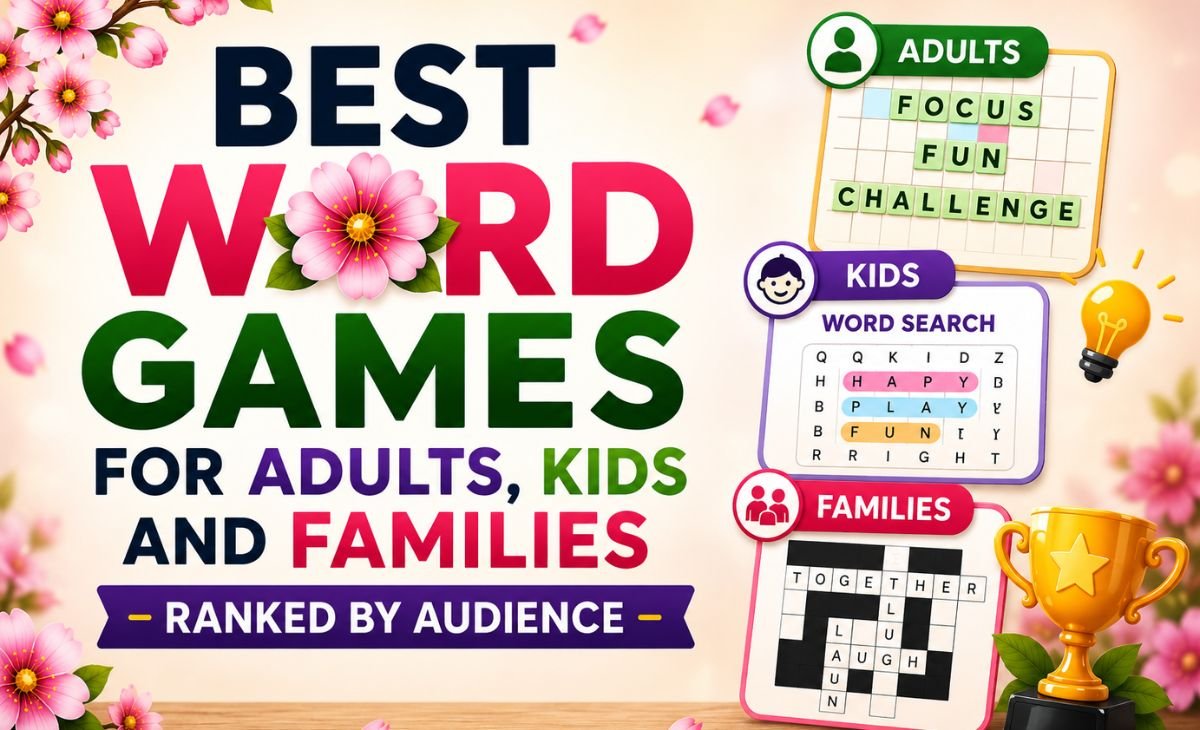
This guide ranks word games by audience — adults, teenagers, families, and children — so you can find the right fit immediately.
Best Word Games for Adults
Adults with developed vocabularies need games with a genuine skill ceiling. The best adult word games offer daily challenges that remain engaging across months and years of play, not just a few sessions.
1. Blossom Word Game — Best Overall for Adults
The Blossom Word Game leads this category by a significant margin. It challenges you to find every valid word from seven letters in a honeycomb grid. Every word must include the center letter. Points are awarded by word length. The pangram bonus rewards the highest-level find.
What makes Blossom the top choice for adults is its skill ceiling. Beginners find enough words to feel productive. Experienced players are challenged by the pursuit of obscure words and pangrams. The gap between a 50-point session and a 200-point session represents genuine vocabulary development, not luck.
Cost: Completely free Platform: Browser (desktop and mobile)
2. NYT Spelling Bee — Best for Adults Who Want Gamification
The same honeycomb format as Blossom, published by the New York Times. Adds difficulty tiers, streaks, and community features. Requires a subscription for the full experience but offers meaningful free access at the basic level.
Cost: Partial free / Subscription Platform: Browser and NYT app
3. NYT Crossword — Best for Knowledge-Based Challenge
The gold standard of daily word puzzles. Tests vocabulary alongside general knowledge, cultural references, and wordplay. The mini crossword is free and takes around five minutes. The full crossword requires a subscription and suits experienced solvers.
Cost: Free (mini) / Subscription (full) Platform: Browser and NYT app
4. Quordle — Best for Adults Who Love Wordle
Four Wordle boards at once. Nine attempts. Considerably harder than standard Wordle and well-suited to adults who have mastered the single-board format and want more challenge within the same mechanic.
Cost: Free (daily) Platform: Browser
Best Word Games for Teenagers (13–18)
Teenagers benefit from games that are genuinely engaging without being condescending. The best options for this age group offer real challenges without requiring an adult vocabulary.
1. Wordle — Best Entry Point
Simple rules, immediate feedback, over in five minutes. Wordle is the right starting point for teenagers new to word games. It teaches deductive reasoning in a clear, satisfying format and is widely played — which means teenagers can compare results with friends.
Cost: Free Platform: Browser
2. Blossom Word Game — Best for Vocabulary-Strong Teenagers
Teenagers with a strong vocabulary enjoy Blossom’s word-building format. The game rewards knowledge they already have and introduces words they do not yet know. The post-game review of missed words is genuinely educational without feeling like schoolwork.
Cost: Free Platform: Browser
3. Dordle — Best Stepping Stone
Two Wordle boards at once. A natural progression for teenagers who find Wordle too easy but are not ready for Quordle’s complexity. Short sessions, clear feedback, appropriate difficulty increase.
Cost: Free Platform: Browser
Best Word Games for Families
Family word games need to work across a range of ages and vocabulary levels. The best family options are accessible to younger players without boring adults.
1. Wordle — Best for Family Play
Wordle works well as a family activity. Everyone guesses the same word. Results can be compared. The simple rules mean younger family members can participate fully. Playing together verbally — where everyone contributes guesses on one shared screen — creates a genuinely collaborative game.
Cost: Free Platform: Browser
2. Waffle — Best Visual Family Game
Six words in an interlocking grid with letters already placed but in wrong positions. The visual layout makes it immediately clear what you are trying to achieve. Families can approach the puzzle collaboratively, with different members suggesting which letters to swap.
Cost: Free Platform: Browser
3. Blossom Word Game — Best Family Vocabulary Game
Playing Blossom as a family — where everyone calls out words they can see — turns the individual puzzle into a collaborative game. Adults handle longer words. Children and teenagers call out shorter ones. The shared goal of finding the pangram gives the session a clear peak.
Cost: Free Platform: Browser
Best Word Games for Children (Under 13)
Younger children need word games with simpler rules, immediate positive feedback, and vocabulary that matches their stage of language development.
1. Word Search Puzzles — Best for Young Children
Word searches require finding hidden words in a grid of letters — a vocabulary task with no guessing mechanic and straightforward rules. Many free word search generators let you create custom puzzles with vocabulary appropriate to a child’s level.
2. Wordle Junior Variants — For Confident Readers
Several unofficial child-friendly Wordle variants use shorter words (three or four letters) and simpler vocabulary. These suit confident young readers aged eight to twelve who are ready for a word game with clear feedback.
3. Scrabble Junior (App) — For Structured Word Building
The official junior version of Scrabble uses shorter words, a simplified scoring system, and a board layout designed for beginners. The app version includes visual hints that help younger players without making the game trivial.
Quick Reference — Word Games by Audience
| Game | Adults | Teenagers | Families | Children |
| Blossom Word Game | ⭐⭐⭐⭐⭐ | ⭐⭐⭐⭐ | ⭐⭐⭐⭐ | ⭐⭐ |
| Wordle | ⭐⭐⭐⭐ | ⭐⭐⭐⭐⭐ | ⭐⭐⭐⭐⭐ | ⭐⭐⭐ |
| NYT Spelling Bee | ⭐⭐⭐⭐⭐ | ⭐⭐⭐ | ⭐⭐⭐ | ⭐ |
| Quordle | ⭐⭐⭐⭐⭐ | ⭐⭐⭐ | ⭐⭐ | ⭐ |
| Waffle | ⭐⭐⭐⭐ | ⭐⭐⭐⭐ | ⭐⭐⭐⭐⭐ | ⭐⭐⭐ |
| NYT Crossword | ⭐⭐⭐⭐⭐ | ⭐⭐ | ⭐⭐ | ⭐ |
| Dordle | ⭐⭐⭐ | ⭐⭐⭐⭐ | ⭐⭐⭐ | ⭐ |
Frequently Asked Questions
What is the best word game for adults who want a real challenge?
Blossom Word Game offers the deepest daily vocabulary challenge available for free. For adults who want gamification on top of the challenge, the NYT Spelling Bee adds difficulty tiers and streaks. For maximum difficulty in the guessing format, Quordle or Octordle.
What word games are suitable for 10-year-olds?
Wordle using shorter word variants, word search puzzles, and family crosswords are the most appropriate for 10-year-olds. Standard Wordle (five-letter words) is accessible for confident readers at this age. Blossom Word Game is better suited to teenagers and adults.
Are there free word games for adults with no download?
Yes. Blossom Word Game, Wordle, Quordle, Waffle, and Phrazle are all free, browser-based, and require no download. They run on any device with a modern browser.
Can families play Blossom Word Game together?
Yes. The most enjoyable family approach is to play on one shared screen with everyone calling out words they can see. Adults typically find longer words while children contribute shorter ones. The shared goal of finding the pangram gives the session a natural peak.
What word game improves vocabulary fastest?
Blossom Word Game and NYT Spelling Bee improve vocabulary faster than guessing games because they require generating words from scratch. The most important habit for vocabulary growth is reviewing missed words after each session and looking up words you do not recognise.
Final Thoughts
The right word game is not about age — it is about what a player wants from the experience and what their vocabulary can currently handle. A teenager with a strong reading habit will outperform a casual adult in Blossom. A family playing Wordle together will enjoy it more than any individual playing alone.
What the rankings in this guide reflect is which games are most likely to land well for each audience at a typical vocabulary level. They are starting points, not rules.
If one game on this list turns out to be easier than expected, the next level up is always available — and always free. If a game feels too hard, stepping back one level is not a failure. It is finding the right challenge.
The best outcome is a daily habit that everyone in the household looks forward to. The games exist to serve that. Find the combination that works and come back to it every morning.